
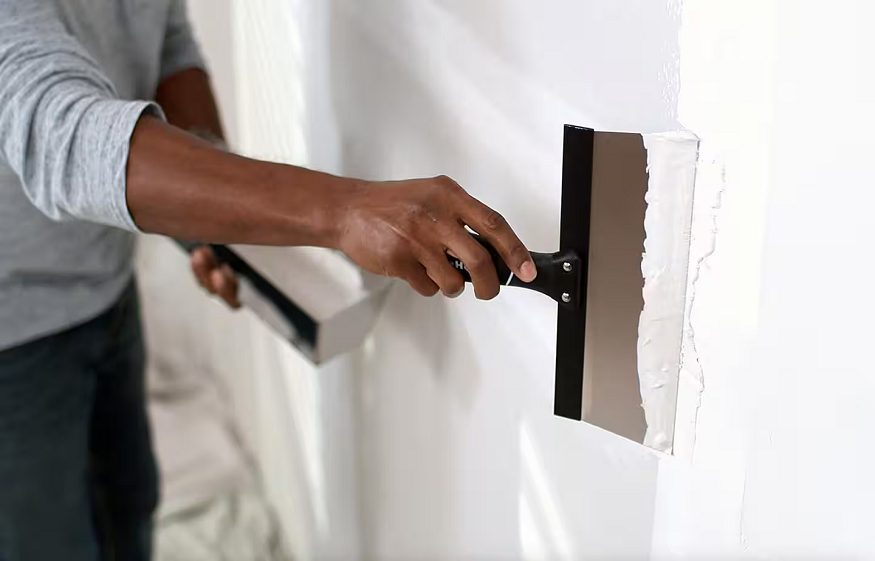
If you’ve ever walked into a freshly painted space that somehow still feels “off,” you’ve already seen what drywall weaknesses look like—just hidden under finish. For you as a property owner, investor, or builder, the real opportunity isn’t in fixing flaws later. It’s in reinforcing them before they surface.
1. Enhancing Surface Chemistry: Where Paint Fails Quietly
Professional painters are true to the fact that a wall that looks clean and smooth can still be a “chemical minefield” that causes your expensive paint to fail within months. Even perfectly sanded walls can fail if the surface isn’t chemically balanced.
Drywall is inconsistent by nature—paper absorbs differently than joint compound. That difference creates weak points for paint adhesion.
A professional finish relies on an advanced Drywall Mudding and Taping strategy—specifically a Level 5 finish—which applies a thin film of joint compound over the entire surface to equalize porosity and eliminate ‘photographing’ of joints through the paint.”
How experts neutralize it:
- Apply a Level 5 skim coat to unify the surface
- Remove all dust using vacuum sanding or microfiber wipe-downs
- Ensure the wall is clean enough that primer bonds directly—not to residue
Quick audit before painting:
- Wipe test: minimal dust = ready surface
- Light test: no flashing or texture variation
This isn’t about appearance alone—it’s about long-term finish stability, especially in humid or high-use environments.
2. Where Cracks Begin: Rethinking the Joint, Not Just Covering It
Every drywall system has a breaking point—and it usually starts at the seams.
Buildings shift, materials expand, and all that movement concentrates stress exactly where boards meet. The difference between average work and expert execution lies here.
What professionals do differently:
- Use paper tape in critical seams and corners for flexibility under stress
- Apply setting-type compound (hot mud) to create a rigid, non-shrinking base
- Feather joints wide enough (12–18 inches minimum) to dissipate tension
Before paint, a grazing light test reveals the truth:
- Shadows = stress buildup
- Visible lines = future cracks
This isn’t cosmetic—it’s structural foresight built into the finish.
3. Mitigating Risks on Corners and Openings: The Silent Stress Zones
Modernized painting firm does not just “apply color”—they take ownership of the substrate integrity. These painting experts understand that doors, windows, and outside corners are where drywall quietly fails first.Why? Because these areas absorb structural movement. Most cracks you see forming diagonally from window corners? That’s predictable—not accidental.
The expert painter countermeasure approach for paint prep:
- Avoid placing joints directly at stress points
- “Wrap” drywall so seams sit 8–12 inches away from corners
- Use vinyl or composite corner beads instead of traditional metal
- They flex slightly instead of cracking
- They bond with compound rather than relying on nails
And during inspection, they:
- Check for “high shoulders” at butt joints
- Ensure corners stay sharp—not overbuilt or rounded
This is precision layout thinking—not just installation.
Read More: Best Ductless Range Hood: The Ultimate Guide To Cleaner, Odor-Free Kitchens
4. Fasteners and Movement: Stopping Nail Pops Before They Start
In modern high-end painting, a “nail pop” isn’t just a drywall issue—it is a surface failure that ruins the defense layer of your paint.Nail pops aren’t random—they’re predictable outcomes of wood movement.
As framing dries and shifts, it pushes fasteners outward. If the drywall isn’t properly secured, those small bumps show up months after finishing—right through your paint.
What high-level installers prioritize:
- Screw-and-glue method for continuous bonding
- Reduced reliance on fasteners alone
- Controlled screw depth using dimpler tools
On-site checks that matter:
- Run a blade across screw lines—any “click” means trouble ahead
- Listen for hollow sounds when tapping walls—signals poor attachment
If the board moves, the finish fails. Professionals eliminate that movement early.
In essence, expert painters can attest to a sophisticated nod that the best foundational paint jobs are invisible.
You don’t notice a perfect joint; you only notice a cracked one.
You don’t notice a stable fastener; you only notice a nail pop.
The ROI: Real value is created when a property owner realizes they won’t have to pay for a “refresh” in two years because the initial “thinking” was sound. When you apply “better thinking” to the convergence of mudding, taping, and painting, the leverage is absolute win.